Probabilistic Object Tracking Using a Range Camera
arXiv Video Code Video


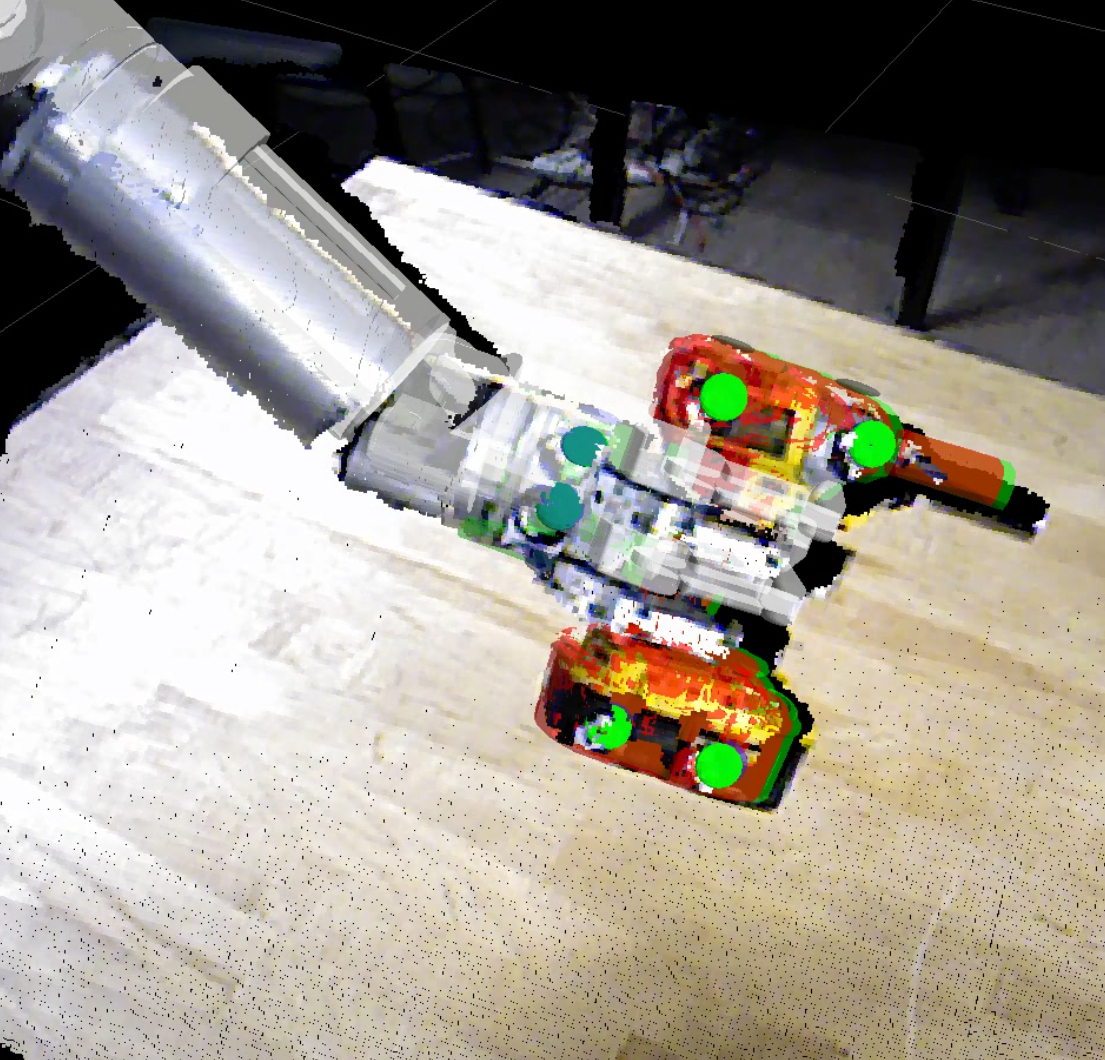
We address the problem of tracking the 6-DoF pose of an object while it is being manipulated by a human or a robot. We use a dynamic Bayesian network to perform inference and compute a posterior distribution over the current object pose. Depending on whether a robot or a human manipulates the object, we employ a process model with or without knowledge of control inputs. Observations are obtained from a range camera. As opposed to previous object tracking methods, we explicitly model self-occlusions and occlusions from the environment, e.g, the human or robotic hand. This leads to a strongly non-linear observation model and additional dependencies in the Bayesian network. We employ a Rao-Blackwellised particle filter to compute an estimate of the object pose at every time step. In a set of experiments, we demonstrate the ability of our method to accurately and robustly track the object pose in real-time while it is being manipulated by a human or a robot.
| Author(s): | Wüthrich, M. and Pastor, P. and Kalakrishnan, M. and Bohg, J. and Schaal, S. |
| Links: | |
| Book Title: | IEEE/RSJ International Conference on Intelligent Robots and Systems |
| Pages: | 3195-3202 |
| Year: | 2013 |
| Month: | November |
| Publisher: | IEEE |
| Project(s): |
|
| BibTeX Type: | Conference Paper (inproceedings) |
| DOI: | 10.1109/IROS.2013.6696810 |
| Electronic Archiving: | grant_archive |
BibTeX
@inproceedings{wuthrich-iros-2013,
  title = {Probabilistic Object Tracking Using a Range Camera},
  booktitle = {IEEE/RSJ International Conference on Intelligent Robots and Systems},
  abstract = {We address the problem of tracking the 6-DoF pose of an object while it is being manipulated by a human or a robot. We use a dynamic Bayesian network to perform inference and compute a posterior distribution over the current object pose. Depending on whether a robot or a human manipulates the object, we employ a process model with or without knowledge of control inputs. Observations are obtained from a range camera. As opposed to previous object tracking methods, we explicitly model self-occlusions and occlusions from the environment, e.g, the human or robotic hand. This leads to a strongly non-linear observation model and additional dependencies in the Bayesian network. We employ a Rao-Blackwellised particle filter to compute an estimate of the object pose at every time step. In a set of experiments, we demonstrate the ability of our method to accurately and robustly track the object pose in real-time while it is being manipulated by a human or a robot.
  },
  pages = {3195-3202},
  publisher = {IEEE},
  month = nov,
  year = {2013},
  author = {W{\"u}thrich, M. and Pastor, P. and Kalakrishnan, M. and Bohg, J. and Schaal, S.},
  doi = {10.1109/IROS.2013.6696810},
  month_numeric = {11}
}