Capturing Hands in Action using Discriminative Salient Points and Physics Simulation
Website pdf


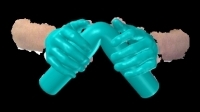
Hand motion capture is a popular research field, recently gaining more attention due to the ubiquity of RGB-D sensors. However, even most recent approaches focus on the case of a single isolated hand. In this work, we focus on hands that interact with other hands or objects and present a framework that successfully captures motion in such interaction scenarios for both rigid and articulated objects. Our framework combines a generative model with discriminatively trained salient points to achieve a low tracking error and with collision detection and physics simulation to achieve physically plausible estimates even in case of occlusions and missing visual data. Since all components are unified in a single objective function which is almost everywhere differentiable, it can be optimized with standard optimization techniques. Our approach works for monocular RGB-D sequences as well as setups with multiple synchronized RGB cameras. For a qualitative and quantitative evaluation, we captured 29 sequences with a large variety of interactions and up to 150 degrees of freedom.
| Author(s): | Dimitrios Tzionas and Luca Ballan and Abhilash Srikantha and Pablo Aponte and Marc Pollefeys and Juergen Gall |
| Links: | |
| Journal: | International Journal of Computer Vision (IJCV) |
| Volume: | 118 |
| Number (issue): | 2 |
| Pages: | 172--193 |
| Year: | 2016 |
| Month: | June |
| Project(s): | |
| BibTeX Type: | Article (article) |
| DOI: | 10.1007/s11263-016-0895-4 |
| State: | Published |
| URL: | https://doi.org/10.1007/s11263-016-0895-4 |
| Electronic Archiving: | grant_archive |
BibTeX
@article{Tzionas:IJCV:2016,
  title = {Capturing Hands in Action using Discriminative Salient Points and Physics Simulation},
  journal = {International Journal of Computer Vision (IJCV)},
  abstract = {Hand motion capture is a popular research field, recently gaining more attention due to the ubiquity of RGB-D sensors. However, even most recent approaches focus on the case of a single isolated hand. In this work, we focus on hands that interact with other hands or objects and present a framework that successfully captures motion in such interaction scenarios for both rigid and articulated objects. Our framework combines a generative model with discriminatively trained salient points to achieve a low tracking error and with collision detection and physics simulation to achieve physically plausible estimates even in case of occlusions and missing visual data. Since all components are unified in a single objective function which is almost everywhere differentiable, it can be optimized with standard optimization techniques. Our approach works for monocular RGB-D sequences as well as setups with multiple synchronized RGB cameras. For a qualitative and quantitative evaluation, we captured 29 sequences with a large variety of interactions and up to 150 degrees of freedom.},
  volume = {118},
  number = {2},
  pages = {172--193},
  month = jun,
  year = {2016},
  author = {Tzionas, Dimitrios and Ballan, Luca and Srikantha, Abhilash and Aponte, Pablo and Pollefeys, Marc and Gall, Juergen},
  doi = {10.1007/s11263-016-0895-4},
  url = {https://doi.org/10.1007/s11263-016-0895-4},
  month_numeric = {6}
}