Creating body shapes from verbal descriptions by linking similarity spaces
pdf


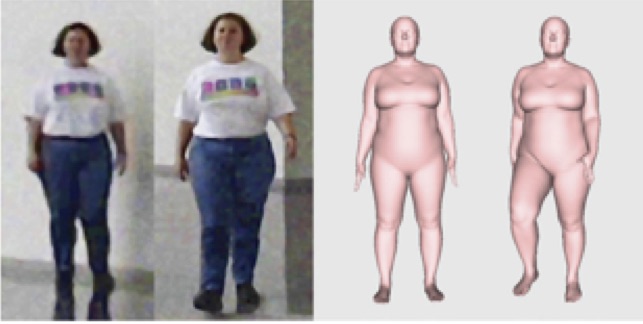
Brief verbal descriptions of bodies (e.g. curvy, long-legged) can elicit vivid mental images. The ease with which we create these mental images belies the complexity of three-dimensional body shapes. We explored the relationship between body shapes and body descriptions and show that a small number of words can be used to generate categorically accurate representations of three-dimensional bodies. The dimensions of body shape variation that emerged in a language-based similarity space were related to major dimensions of variation computed directly from three-dimensional laser scans of 2094 bodies. This allowed us to generate three-dimensional models of people in the shape space using only their coordinates on analogous dimensions in the language-based description space. Human descriptions of photographed bodies and their corresponding models matched closely. The natural mapping between the spaces illustrates the role of language as a concise code for body shape, capturing perceptually salient global and local body features.
| Author(s): | Matthew Q. Hill and Stephan Streuber and Carina A. Hahn and Michael J. Black and Alice J. O’Toole |
| Links: | |
| Journal: | Psychological Science |
| Volume: | 27 |
| Number (issue): | 11 |
| Pages: | 1486--1497 |
| Year: | 2016 |
| Month: | November |
| Project(s): | |
| BibTeX Type: | Article (article) |
| Electronic Archiving: | grant_archive |
BibTeX
@article{PsychSci:2016,
  title = {Creating body shapes from verbal descriptions by linking similarity spaces},
  journal = {Psychological Science},
  abstract = {Brief verbal descriptions of bodies (e.g. curvy, long-legged) can elicit vivid mental images. The ease with which we create these mental images belies the complexity of three-dimensional body shapes. We explored the relationship between body shapes and body descriptions and show that a small number of words can be used to generate categorically accurate representations of three-dimensional bodies. The dimensions of body shape variation that emerged in a language-based similarity space were related to major dimensions of variation computed directly from three-dimensional laser scans of 2094 bodies. This allowed us to generate three-dimensional models of people in the shape space using only their coordinates on analogous dimensions in the language-based description space. Human descriptions of photographed bodies and their corresponding models matched closely. The natural mapping between the spaces illustrates the role of language as a concise code for body shape, capturing perceptually salient global and local body features.},
  volume = {27},
  number = {11},
  pages = {1486--1497},
  month = nov,
  year = {2016},
  author = {Hill, Matthew Q. and Streuber, Stephan and Hahn, Carina A. and Black, Michael J. and O'Toole, Alice J.},
  note = { },
  month_numeric = {11}
}