

Probabilistic Numerics


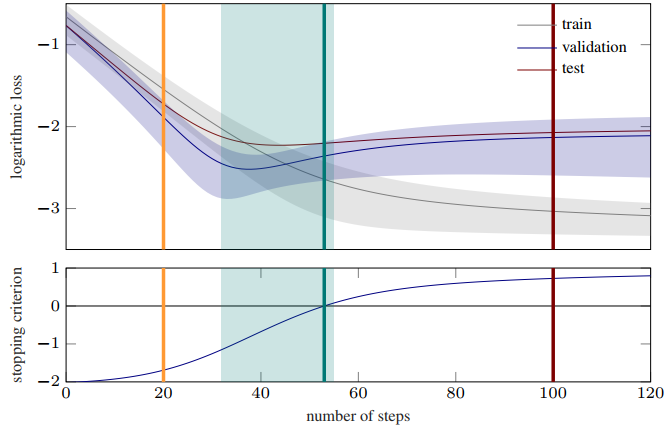
Early stopping is a widely used technique to prevent poor generalization performance when training an over-expressive model by means of gradient-based optimization. To find a good point to halt the optimizer, a common practice is to split the dataset into a training and a smaller validation set to obtain an ongoing estimate of the generalization performance. In this paper we propose a novel early stopping criterion which is based on fast-to-compute, local statistics of the computed gradients and entirely removes the need for a held-out validation set. Our experiments show that this is a viable approach in the setting of least-squares and logistic regression as well as neural networks.
| Author(s): | Maren Mahsereci and Lukas Balles and Christoph Lassner and Philipp Hennig |
| Journal: | arXiv preprint arXiv:1703.09580 |
| Year: | 2017 |
| Project(s): | |
| Bibtex Type: | Article (article) |
| URL: | https://arxiv.org/abs/1703.09580 |
| Electronic Archiving: | grant_archive |
BibTex
@article{Mahsereci:EarlyStopping:2017,
  title = {Early Stopping Without a Validation Set},
  journal = {arXiv preprint arXiv:1703.09580},
  abstract = {Early stopping is a widely used technique to prevent poor generalization performance when training an over-expressive model by means of gradient-based optimization. To find a good point to halt the optimizer, a common practice is to split the dataset into a training and a smaller validation set to obtain an ongoing estimate of the generalization performance. In this paper we propose a novel early stopping criterion which is based on fast-to-compute, local statistics of the computed gradients and entirely removes the need for a held-out validation set. Our experiments show that this is a viable approach in the setting of least-squares and logistic regression as well as neural networks.},
  year = {2017},
  slug = {mahsereci-earlystopping-2017},
  author = {Mahsereci, Maren and Balles, Lukas and Lassner, Christoph and Hennig, Philipp},
  url = {https://arxiv.org/abs/1703.09580}
}