




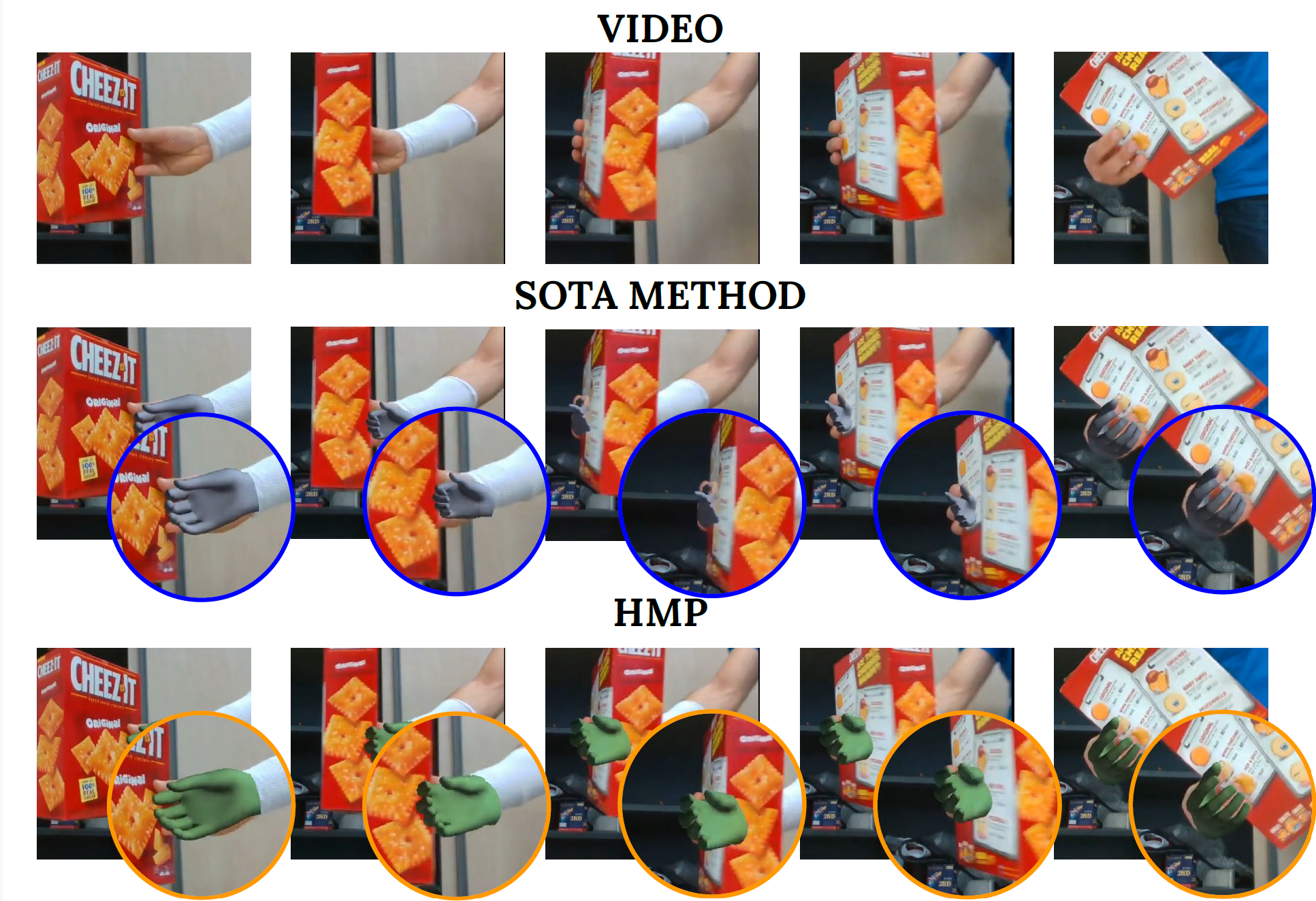
Understanding how humans interact with the world necessitates accurate 3D hand pose estimation, a task complicated by the hand’s high degree of articulation, frequent occlusions, self-occlusions, and rapid motions. While most existing methods rely on single-image inputs, videos have useful cues to address aforementioned issues. However, existing video-based 3D hand datasets are insufficient for training feedforward models to generalize to in-the-wild scenarios. On the other hand, we have access to large human motion capture datasets which also include hand motions, e.g. AMASS. Therefore, we develop a generative motion prior specific for hands, trained on the AMASS dataset which features diverse and high-quality hand motions. This motion prior is then employed for video-based 3D hand motion estimation following a latent optimization approach. Our integration of a robust motion prior significantly enhances performance, especially in occluded scenarios. It produces stable, temporally consistent results that surpass conventional single-frame methods. We demonstrate our method’s efficacy via qualitative and quantitative evaluations on the HO3D and DexYCB datasets, with special emphasis on an occlusion-focused subset of HO3D.
| Author(s): | Duran, Enes and Kocabas, Muhammed and Choutas, Vasileios and Fan, Zicong and Black, Michael J. |
| Links: | |
| Journal: | Proceedings of the IEEE/CVF Winter Conference on Applications of Computer Vision (WACV) |
| Year: | 2024 |
| Month: | January |
| BibTeX Type: | Article (article) |
| State: | Published |
| Electronic Archiving: | grant_archive |
BibTeX
@article{HMP,
  title = {{HMP}: Hand Motion Priors for Pose and Shape Estimation from Video},
  journal = {Proceedings of the IEEE/CVF Winter Conference on Applications of Computer Vision (WACV)},
  abstract = {Understanding how humans interact with the world necessitates accurate 3D hand pose estimation, a task complicated by the hand’s high degree of articulation, frequent occlusions, self-occlusions, and rapid motions. While most existing methods rely on single-image inputs, videos have useful cues to address aforementioned issues. However, existing video-based 3D hand datasets are insufficient for training feedforward models to generalize to in-the-wild scenarios. On the other hand, we have access to large human motion capture datasets which also include hand motions, e.g. AMASS. Therefore, we develop a generative motion prior specific for hands, trained on the AMASS dataset which features diverse and high-quality hand motions. This motion prior is then employed for video-based 3D hand motion estimation following a latent optimization approach. Our integration of a robust motion prior significantly enhances performance, especially in occluded scenarios. It produces stable, temporally consistent results that surpass conventional single-frame methods. We demonstrate our method’s efficacy via qualitative and quantitative evaluations on the HO3D and DexYCB datasets, with special emphasis on an occlusion-focused subset of HO3D.},
  month = jan,
  year = {2024},
  author = {Duran, Enes and Kocabas, Muhammed and Choutas, Vasileios and Fan, Zicong and Black, Michael J.},
  month_numeric = {1}
}