




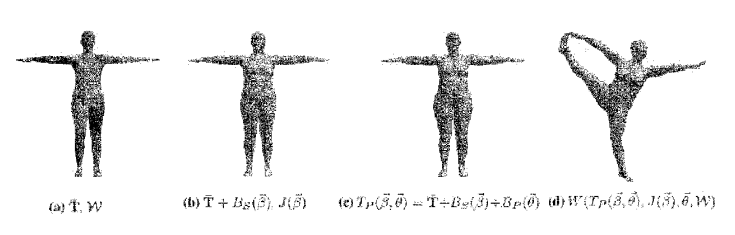
The invention comprises a learned model of human body shape and pose dependent shape variation that is more accurate than previous models and is compatible with existing graphics pipelines. Our Skinned Multi-Person Linear model (SMPL) is a skinned vertex based model that accurately represents a wide variety of body shapes in natural human poses. The parameters of the model are learned from data including the rest pose template, blend weights, pose-dependent blend shapes, identity- dependent blend shapes, and a regressor from vertices to joint locations. Unlike previous models, the pose-dependent blend shapes are a linear function of the elements of the pose rotation matrices. This simple formulation enables training the entire model from a relatively large number of aligned 3D meshes of different people in different poses. The invention quantitatively evaluates variants of SMPL using linear or dual- quaternion blend skinning and show that both are more accurate than a Blend SCAPE model trained on the same data. In a further embodiment, the invention realistically models dynamic soft-tissue deformations. Because it is based on blend skinning, SMPL is compatible with existing rendering engines and we make it available for research purposes.
| Author(s): | Black, M.J. and Loper, M. and Mahmood, N. and Pons-Moll, G. and Romero, J. |
| Links: | |
| Year: | 2016 |
| Month: | December |
| BibTeX Type: | Patent (patent) |
| Electronic Archiving: | grant_archive |
| Note: | Application PCT/EP2016/064610 |
BibTeX
@patent{Black:SMPL:2016,
  title = {Skinned multi-person linear model},
  abstract = {The invention comprises a learned model of human body shape and pose dependent shape variation that is more accurate than previous models and is compatible with existing graphics pipelines. Our Skinned Multi-Person Linear model (SMPL) is a skinned vertex based model that accurately represents a wide variety of body shapes in natural human poses. The parameters of the model are learned from data including the rest pose template, blend weights, pose-dependent blend shapes, identity- dependent blend shapes, and a regressor from vertices to joint locations. Unlike previous models, the pose-dependent blend shapes are a linear function of the elements of the pose rotation matrices. This simple formulation enables training the entire model from a relatively large number of aligned 3D meshes of different people in different poses. The invention quantitatively evaluates variants of SMPL using linear or dual- quaternion blend skinning and show that both are more accurate than a Blend SCAPE model trained on the same data. In a further embodiment, the invention realistically models dynamic soft-tissue deformations. Because it is based on blend skinning, SMPL is compatible with existing rendering engines and we make it available for research purposes.
  },
  month = dec,
  year = {2016},
  note = {Application PCT/EP2016/064610},
  author = {Black, M.J. and Loper, M. and Mahmood, N. and Pons-Moll, G. and Romero, J.},
  month_numeric = {12}
}