PLAYBOT: A visually-guided robot for physically disabled children
pdf pdf from publisher
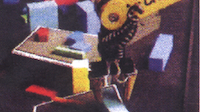
This paper overviews the PLAYBOT project, a long-term, large-scale research program whose goal is to provide a directable robot which may enable physically disabled children to access and manipulate toys. This domain is the first test domain, but there is nothing inherent in the design of PLAYBOT that prohibits its extension to other tasks. The research is guided by several important goals: vision is the primary sensor; vision is task directed; the robot must be able to visually search its environment; object and event recognition are basic capabilities; environments must be natural and dynamic; users and environments are assumed to be unpredictable; task direction and reactivity must be smoothly integrated; and safety is of high importance. The emphasis of the research has been on vision for the robot this is the most challenging research aspect and the major bottleneck to the development of intelligent robots. Since the control framework is behavior-based, the visual capabilities of PLAYBOT are described in terms of visual behaviors. Many of the components of PLAYBOT are briefly described and several examples of implemented sub-systems are shown. The paper concludes with a description of the current overall system implementation, and a complete example of PLAYBOT performing a simple task.
| Author(s): | Tsotsos, J. K. and Verghese, G. and Dickinson, S. and Jenkin, M. and Jepson, A. and Milios, E. and Nuflo, F. and Stevenson, S. and Black, M. and Metaxas, D. and Culhane, S. and Ye, Y. and Mann, R. |
| Links: | |
| Journal: | Image & Vision Computing, Special Issue on Vision for the Disabled |
| Volume: | 16 |
| Number (issue): | 4 |
| Pages: | 275--292 |
| Year: | 1998 |
| BibTeX Type: | Article (article) |
| DOI: | 10.1016/S0262-8856(97)00088-7 |
| Electronic Archiving: | grant_archive |
BibTeX
@article{Black:IVC:1998,
  title = {{PLAYBOT}: A visually-guided robot for physically disabled children},
  journal = {Image & Vision Computing, Special Issue on Vision for the Disabled},
  abstract = {This paper overviews the PLAYBOT project, a long-term, large-scale research program whose goal is to provide a directable robot which may enable physically disabled children to access and manipulate toys. This domain is the first test domain, but there is nothing inherent in the design of PLAYBOT that prohibits its extension to other tasks. The research is guided by several important goals: vision is the primary sensor; vision is task directed; the robot must be able to visually search its environment; object and event recognition are basic capabilities; environments must be natural and dynamic; users and environments are assumed to be unpredictable; task direction and reactivity must be smoothly integrated; and safety is of high importance. The emphasis of the research has been on vision for the robot this is the most challenging research aspect and the major bottleneck to the development of intelligent robots. Since the control framework is behavior-based, the visual capabilities of PLAYBOT are described in terms of visual behaviors. Many of the components of PLAYBOT are briefly described and several examples of implemented sub-systems are shown. The paper concludes with a description of the current overall system implementation, and a complete example of PLAYBOT performing a simple task.
  },
  volume = {16},
  number = {4},
  pages = {275--292},
  year = {1998},
  author = {Tsotsos, J. K. and Verghese, G. and Dickinson, S. and Jenkin, M. and Jepson, A. and Milios, E. and Nuflo, F. and Stevenson, S. and Black, M. and Metaxas, D. and Culhane, S. and Ye, Y. and Mann, R.},
  doi = {10.1016/S0262-8856(97)00088-7}
}