News & Awards
Perceiving Systems
News
16-12-2015
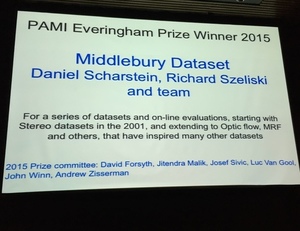
Middlebury Dataset awarded 2015 IEEE Mark Everingham Prize
The 2015 PAMI Mark Everingham Prize was awarded to the Middlebury Dataset (Daniel Scharstein, Richard Szeliski, and team) for a series of datasets and on-line evaluations, starting with the Stereo datasets in 2001, and extending to Optical Flow, MRF and others, which have inspired many other datasets. Michael Black was part of the team behind the Optical Flow dataset and evaluation.
Michael Black
Perceiving Systems
Autonomous Vision
News
22-10-2015
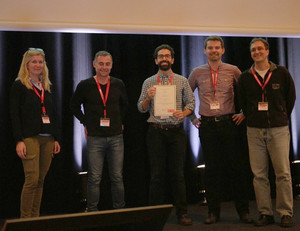
Ali Osman Ulusoy, Andreas Geiger and Michael Black receive 3DV 2015 Best Paper Award
Ali Osman Ulusoy, Andreas Geiger and Michael Black receive the Best Paper Award at this years 3D Vision Conference for their paper "Towards Probabilistic Volumetric Reconstruction using Ray Potentials".
Osman Ulusoy
Andreas Geiger
Michael Black
Perceiving Systems
Autonomous Vision
News
09-10-2015
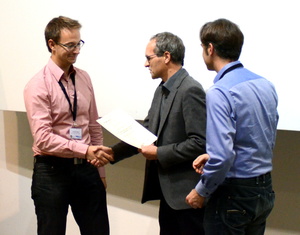
Andreas Geiger and Chaohui Wang receive GCPR 2015 Best Paper Award
Andreas Geiger receiving the GCPR 2015 Best Paper Award from Reinhard Koch (president of DAGM) and Bastian Leibe (general chair of GCPR 2015) for their paper "Joint 3D Object and Layout Inference from a single RGB-D Image".
Andreas Geiger
Chaohui Wang
Perceiving Systems
News
11-08-2015
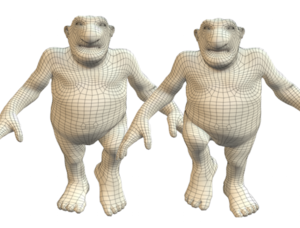
4D Movies Capture Every Jiggle, Creating Realistic Digital Avatars
Researchers at the Max Planck Institute for Intelligent Systems unveil the world’s first high-resolution 4D body scanner and software to model detailed soft-tissue motion.
Everybody jiggles” according Dr. Michael Black, Director at the Max Planck Institute for Intelligent Systems (MPI-IS) in Tübingen, Germany. We may not like it, but how we jiggle says a lot about who we are. Our soft tissue (otherwise known as fat and muscle) deforms, wobbles, waves, and bounces as we move. These motions may provide clues about our risk for cardiovascular disease and diabetes. They also make us look real. Digital characters either lack natural soft-tissue motion or require time-consuming animation to make them believable. Now researchers at MPI-IS have captured people and how they jiggle in exacting detail and have created realistic 3D avatars that bring natural body motions to digital characters.
Michael Black
Gerard Pons-Moll
Javier Romero
Naureen Mahmood
Perceiving Systems
News
10-07-2015
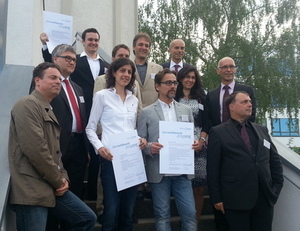
Third prize in the "Science2Start" Competition
The Science2Start programme is geared towards scientists interested in founding start-ups and helps putting their business ideas in the field of life sciences into practice.
Detection of new or rapidly evolving melanocytic lesions is crucial for early diagnosis and treatment of melanoma.
Federica Bogo
Perceiving Systems
News
15-06-2015
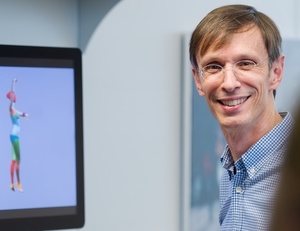
Michael J. Black elected as foreign member of the Royal Swedish Academy of Sciences
Three new members elected to the Academy
Michael Black
Perceiving Systems
Autonomous Vision
News
10-02-2015
Outstanding Doctorate Thesis within the KIT Research Field "Systems and Processes"
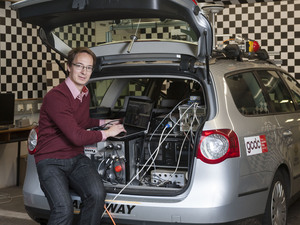
Andreas Geiger has been awarded the KIT Doctoral Award
In his PhD thesis, Andreas Geiger has developed algorithms for 3D scene perception in autonomous vehicles which can help to improve traffic safety, reduce traffic jams and enable car rides for elderly or visually impaired people. His approach combines visual recognition using stereo cameras with probabilistic models which are able to determine the location and orientation of roads, lanes and other traffic participants.
Andreas Geiger
Perceiving Systems
News
08-12-2014
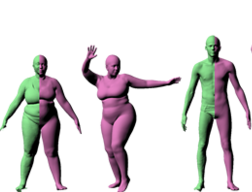
Tiny motions bring digital doubles to life
Researchers at the Max Planck Institute for Intelligent Systems unveil new technology for motion and shape capture
The new technology (MoSh) will help animators jump the “Uncanny Valley” by turning a few moving dots into detailed body shapes that jiggle and deform like real humans. Researchers at the Max Planck Institute for Intelligent Systems in Tübingen, presented their Motion and Shape Capture (MoSh) study, which appeared in the journal ACM Transactions on Graphics, at SIGGRAPH Asia in Shenzhen on December 6, 2014. Devised by a team of researchers under the direction of Michael J. Black, Director of the Perceiving Systems department, MoSh is a method that allows animators to record the three-dimensional (3D) motion and shape of a real human and digitally “retarget” it to a new body shape. With MoSh, realistic virtual humans can populate games, the Internet, and virtual reality, while reducing animation costs for the special effects industry.
Michael Black
Perceiving Systems
Autonomous Vision
News
28-11-2014
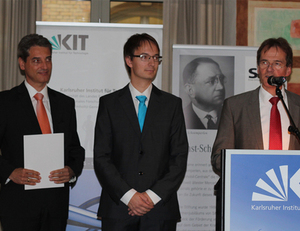
Andreas Geiger´s PhD thesis is awarded prize by KIT mobility center
KIT-Zentrum für Mobilitätssysteme zeichnet Doktorarbeit von Andreas Geiger aus
Für ein autonomes Fahrzeug bedeutet eine innerstädtische Kreuzung mit mehreren Verkehrsteilnehmern eine große Herausforderung. Wie komplexe Verkehrssituationen mithilfe von Videosequenzen besser verstanden werden können, hat Dr. Andreas Geiger in seiner Doktorarbeit gezeigt. Dafür hat er am 27. November 2014 vom KIT-Zentrum für Mobilitätssysteme den Ernst-Schoemperlen-Preis verliehen bekommen.
Andreas Geiger
Perceiving Systems
News
01-12-2013
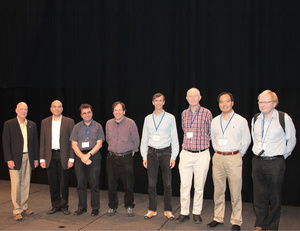
Michael Black awarded 2013 Helmholtz Prize
2013 Helmholtz Prize honors Michael J. Black's work on robust optical flow estimation described in the ICCV 1993 paper with P. Anandan on "A framework for the robust estimation of optical flow."
Michael Black
Perceiving Systems
News
17-02-2011
Robots learn human perception
Michael J. Black teaches computers to analyse data on their environment as quickly and reliably as the human brain.