On the Design of LQR Kernels for Efficient Controller Learning
arXiv PDF On the Design of LQR Kernels for Efficient Controller Learning - CDC presentation



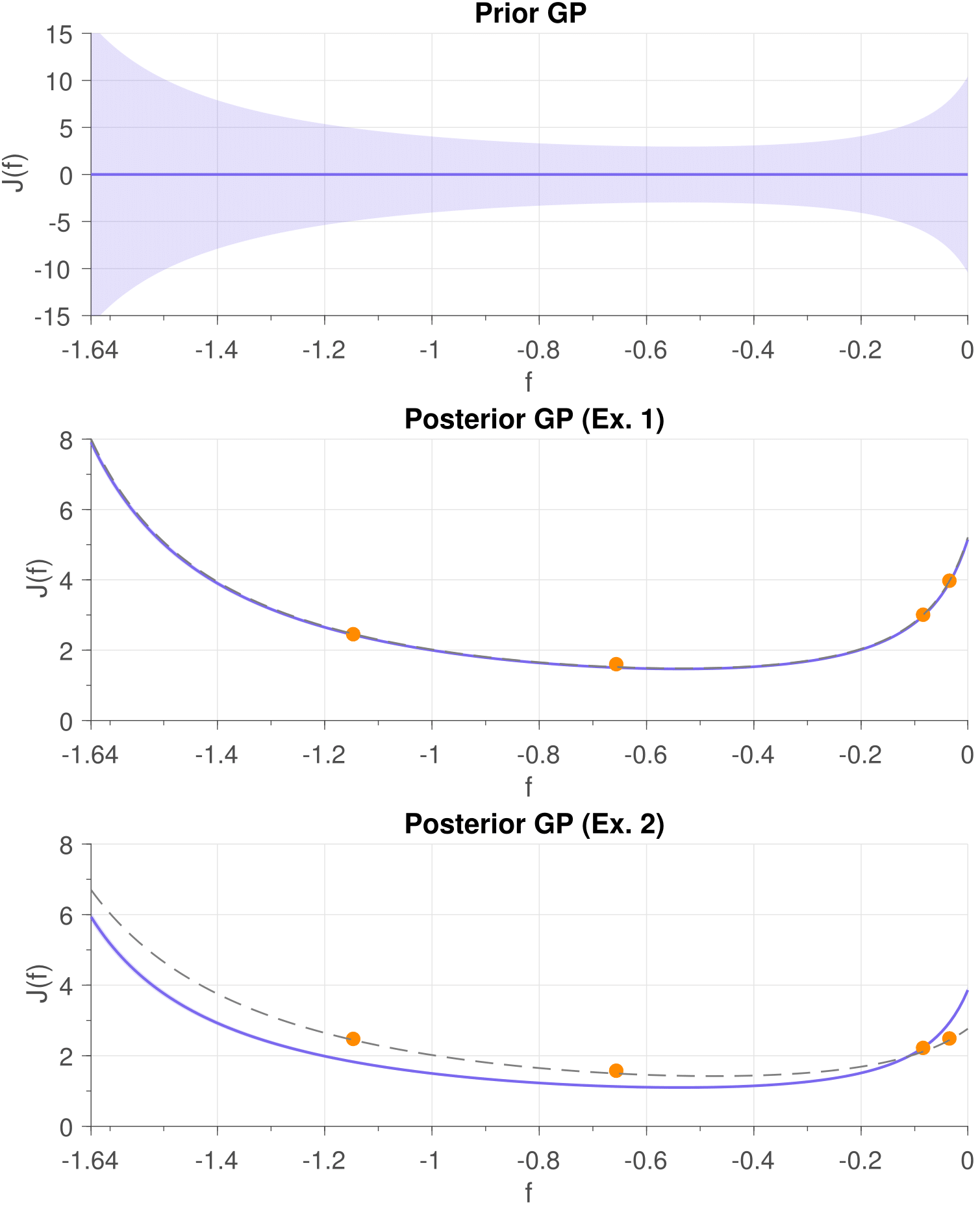
Finding optimal feedback controllers for nonlinear dynamic systems from data is hard. Recently, Bayesian optimization (BO) has been proposed as a powerful framework for direct controller tuning from experimental trials. For selecting the next query point and finding the global optimum, BO relies on a probabilistic description of the latent objective function, typically a Gaussian process (GP). As is shown herein, GPs with a common kernel choice can, however, lead to poor learning outcomes on standard quadratic control problems. For a first-order system, we construct two kernels that specifically leverage the structure of the well-known Linear Quadratic Regulator (LQR), yet retain the flexibility of Bayesian nonparametric learning. Simulations of uncertain linear and nonlinear systems demonstrate that the LQR kernels yield superior learning performance.
| Author(s): | Alonso Marco and Philipp Hennig and Stefan Schaal and Sebastian Trimpe |
| Links: | |
| Book Title: | Proceedings of the 56th IEEE Annual Conference on Decision and Control (CDC) |
| Pages: | 5193--5200 |
| Year: | 2017 |
| Month: | December |
| Day: | 12-15 |
| Publisher: | IEEE |
| Project(s): |
|
| BibTeX Type: | Conference Paper (conference) |
| DOI: | 10.1109/CDC.2017.8264429 |
| Event Name: | IEEE Conference on Decision and Control |
| Event Place: | Melbourne, VIC, Australia |
| State: | Published |
| Electronic Archiving: | grant_archive |
BibTeX
@conference{MaHeScTr17,
  title = {On the Design of {LQR} Kernels for Efficient Controller Learning},
  booktitle = {Proceedings of the 56th IEEE Annual Conference on Decision and Control (CDC)},
  abstract = {Finding optimal feedback controllers for nonlinear dynamic systems from data
  is hard. Recently, Bayesian optimization (BO) has been proposed as a powerful
  framework for direct controller tuning from experimental trials. For selecting
  the next query point and finding the global optimum, BO relies on a
  probabilistic description of the latent objective function, typically a
  Gaussian process (GP). As is shown herein, GPs with a common kernel choice can,
  however, lead to poor learning outcomes on standard quadratic control problems.
  For a first-order system, we construct two kernels that specifically leverage
  the structure of the well-known Linear Quadratic Regulator (LQR), yet retain
  the flexibility of Bayesian nonparametric learning. Simulations of uncertain
  linear and nonlinear systems demonstrate that the LQR kernels yield superior
  learning performance.},
  pages = {5193--5200},
  publisher = {IEEE},
  month = dec,
  year = {2017},
  author = {Marco, Alonso and Hennig, Philipp and Schaal, Stefan and Trimpe, Sebastian},
  doi = {10.1109/CDC.2017.8264429},
  month_numeric = {12}
}