Nanoscale detection of spin wave deflection angles in permalloy



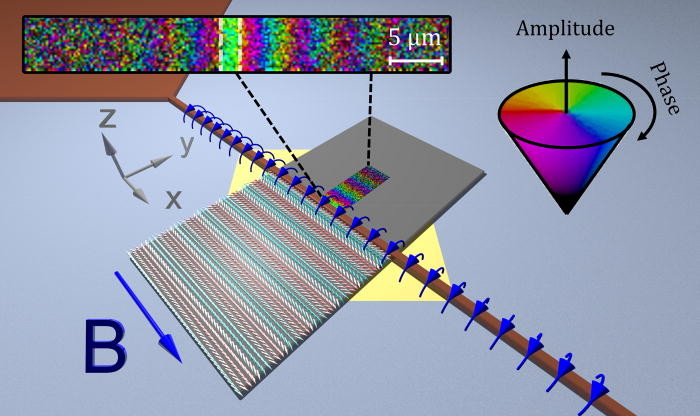
Magnonics is a potential candidate for beyond CMOS and neuromorphic computing technologies with advanced phase encoded logic. However, nanoscale imaging of spin waves with full phase and magnetization amplitude information is a challenge. We show a generalized scanning transmission x-ray microscopy platform to get a complete understanding of spin waves, including the k-vector, phase, and absolute magnetization deflection angle. As an example, this is demonstrated using a 50 nm thin permalloy film where we find a maximum deflection angle of 1.5° and good agreement with the k-vector dispersion previously reported in the literature. With a spatial resolution approximately ten times better than any other methods for spin wave imaging, x-ray microscopy opens a vast range of possibilities for the observation of spin waves and various magnetic structures.
| Author(s): | Gross, F. and Träger, N. and Förster, J. and Weigand, M. and Schütz, G. and Gräfe, J. |
| Journal: | {Applied Physics Letters} |
| Volume: | 114 |
| Number (issue): | 1 |
| Year: | 2019 |
| Publisher: | American Institute of Physics |
| BibTeX Type: | Article (article) |
| DOI: | 10.1063/1.5074169 |
| Address: | Melville, NY |
| Electronic Archiving: | grant_archive |
| Language: | eng |
BibTeX
@article{escidoc:3018734,
  title = {{Nanoscale detection of spin wave deflection angles in permalloy}},
  journal = {{Applied Physics Letters}},
  abstract = {Magnonics is a potential candidate for beyond CMOS and neuromorphic computing technologies with advanced phase encoded logic. However, nanoscale imaging of spin waves with full phase and magnetization amplitude information is a challenge. We show a generalized scanning transmission x-ray microscopy platform to get a complete understanding of spin waves, including the k-vector, phase, and absolute magnetization deflection angle. As an example, this is demonstrated using a 50 nm thin permalloy film where we find a maximum deflection angle of 1.5° and good agreement with the k-vector dispersion previously reported in the literature. With a spatial resolution approximately ten times better than any other methods for spin wave imaging, x-ray microscopy opens a vast range of possibilities for the observation of spin waves and various magnetic structures.},
  volume = {114},
  number = {1},
  publisher = {American Institute of Physics},
  address = {Melville, NY},
  year = {2019},
  author = {Gross, F. and Tr\"ager, N. and F\"orster, J. and Weigand, M. and Sch\"utz, G. and Gr\"afe, J.},
  doi = {10.1063/1.5074169}
}