Microchannels with Self-Pumping Walls







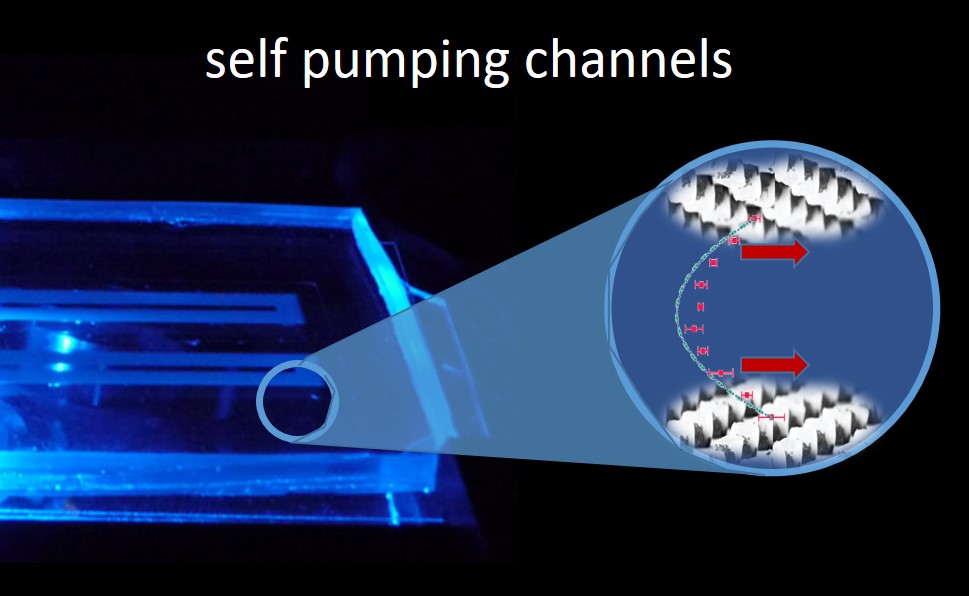
When asymmetric Janus micromotors are immobilized on a surface, they act as chemically powered micropumps, turning chemical energy from the fluid into a bulk flow. However, such pumps have previously produced only localized recirculating flows, which cannot be used to pump fluid in one direction. Here, we demonstrate that an array of three-dimensional, photochemically active Au/TiO2 Janus pillars can pump water. Upon UV illumination, a water-splitting reaction rapidly creates a directional bulk flow above the active surface. By lining a 2D microchannel with such active surfaces, various flow profiles are created within the channels. Analytical and numerical models of a channel with active surfaces predict flow profiles that agree very well with the experimental results. The light-driven active surfaces provide a way to wirelessly pump fluids at small scales and could be used for real-time, localized flow control in complex microfluidic networks.
| Author(s): | Yu, T. and Athanassiadis, A. G. and Popescu, M. N. and Chikkadi, V. and Güth, A. and Singh, D. P. and Qiu, T. and Fischer, P. |
| Journal: | ACS Nano |
| Volume: | 14 |
| Number (issue): | 10 |
| Pages: | 13673--13680 |
| Year: | 2020 |
| Month: | September |
| BibTeX Type: | Article (article) |
| DOI: | 10.1021/acsnano.0c05826 |
| URL: | https://pubs.acs.org/doi/abs/10.1021/acsnano.0c05826 |
| Electronic Archiving: | grant_archive |
BibTeX
@article{2020Yu,
  title = {Microchannels with Self-Pumping Walls},
  journal = {ACS Nano},
  abstract = {When asymmetric Janus micromotors are immobilized on a surface, they act as chemically powered micropumps, turning chemical energy from the fluid into a bulk flow. However, such pumps have previously produced only localized recirculating flows, which cannot be used to pump fluid in one direction. Here, we demonstrate that an array of three-dimensional, photochemically active Au/TiO2 Janus pillars can pump water. Upon UV illumination, a water-splitting reaction rapidly creates a directional bulk flow above the active surface. By lining a 2D microchannel with such active surfaces, various flow profiles are created within the channels. Analytical and numerical models of a channel with active surfaces predict flow profiles that agree very well with the experimental results. The light-driven active surfaces provide a way to wirelessly pump fluids at small scales and could be used for real-time, localized flow control in complex microfluidic networks.},
  volume = {14},
  number = {10},
  pages = {13673--13680},
  month = sep,
  year = {2020},
  author = {Yu, T. and Athanassiadis, A. G. and Popescu, M. N. and Chikkadi, V. and G{\"u}th, A. and Singh, D. P. and Qiu, T. and Fischer, P.},
  doi = {10.1021/acsnano.0c05826},
  url = {https://pubs.acs.org/doi/abs/10.1021/acsnano.0c05826},
  month_numeric = {9}
}