Interface-mediated spontaneous symmetry breaking and mutual communication between drops containing chemically active particles






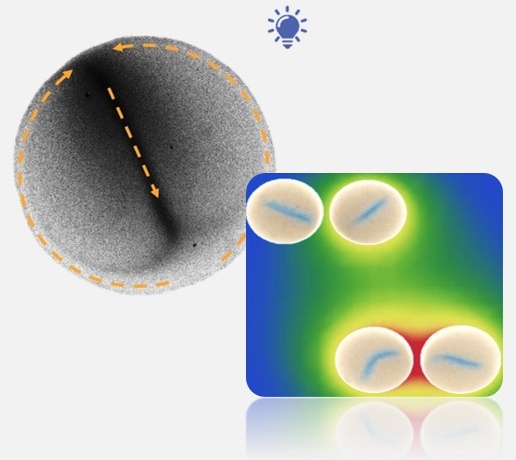
Symmetry breaking and the emergence of self-organized patterns is the hallmark of com- plexity. Here, we demonstrate that a sessile drop, containing titania powder particles with negligible self-propulsion, exhibits a transition to collective motion leading to self-organized flow patterns. This phenomenology emerges through a novel mechanism involving the interplay between the chemical activity of the photocatalytic particles, which induces Mar- angoni stresses at the liquid–liquid interface, and the geometrical confinement provided by the drop. The response of the interface to the chemical activity of the particles is the source of a significantly amplified hydrodynamic flow within the drop, which moves the particles. Furthermore, in ensembles of such active drops long-ranged ordering of the flow patterns within the drops is observed. We show that the ordering is dictated by a chemical com- munication between drops, i.e., an alignment of the flow patterns is induced by the gradients of the chemicals emanating from the active particles, rather than by hydrodynamic interactions.
| Author(s): | Singh, D. P. and Domínguez, A. and Choudhury, U. and Kottapalli, S. N. and Popescu, M. N. and Dietrich, S. and Fischer, P. |
| Journal: | Nature Communications |
| Volume: | 11 |
| Pages: | 2210 |
| Year: | 2020 |
| Month: | May |
| Day: | 5 |
| BibTeX Type: | Article (article) |
| DOI: | 10.1038/s41467-020-15713-y |
| URL: | https://www.nature.com/articles/s41467-020-15713-y |
| Electronic Archiving: | grant_archive |
BibTeX
@article{2020Singh,
  title = {Interface-mediated spontaneous symmetry breaking and mutual communication between drops containing chemically active particles},
  journal = {Nature Communications},
  abstract = {Symmetry breaking and the emergence of self-organized patterns is the hallmark of com-
  plexity. Here, we demonstrate that a sessile drop, containing titania powder particles with
  negligible self-propulsion, exhibits a transition to collective motion leading to self-organized
  flow patterns. This phenomenology emerges through a novel mechanism involving the
  interplay between the chemical activity of the photocatalytic particles, which induces Mar-
  angoni stresses at the liquid–liquid interface, and the geometrical confinement provided by
  the drop. The response of the interface to the chemical activity of the particles is the source
  of a significantly amplified hydrodynamic flow within the drop, which moves the particles.
  Furthermore, in ensembles of such active drops long-ranged ordering of the flow patterns
  within the drops is observed. We show that the ordering is dictated by a chemical com-
  munication between drops, i.e., an alignment of the flow patterns is induced by the gradients
  of the chemicals emanating from the active particles, rather than by hydrodynamic
  interactions.},
  volume = {11},
  pages = {2210},
  month = may,
  year = {2020},
  author = {Singh, D. P. and Domínguez, A. and Choudhury, U. and Kottapalli, S. N. and Popescu, M. N. and Dietrich, S. and Fischer, P.},
  doi = {10.1038/s41467-020-15713-y},
  url = {https://www.nature.com/articles/s41467-020-15713-y},
  month_numeric = {5}
}