Virtual Reality Treatment Displaying the Missing Leg Improves Phantom Limb Pain: A Small Clinical Trial

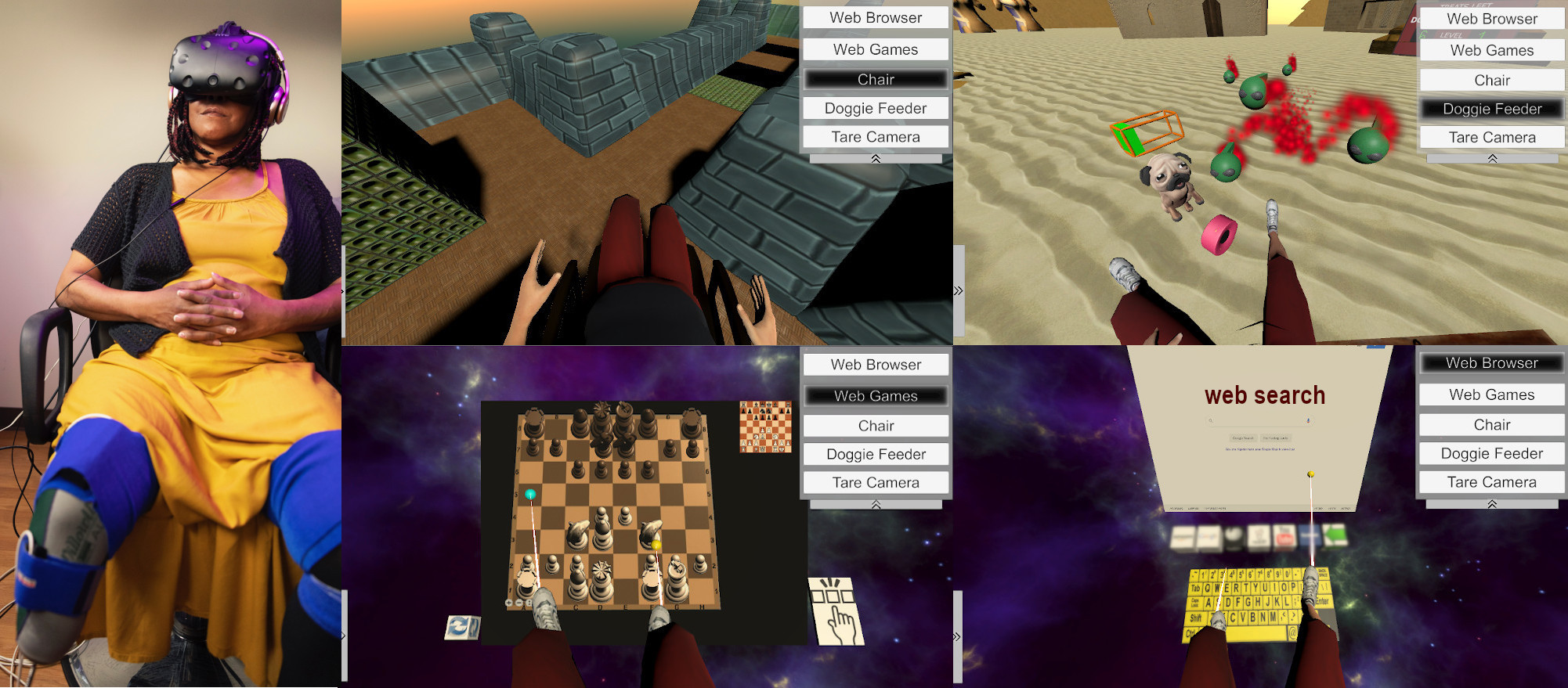
Background: Phantom limb pain (PLP) is a common and in some cases debilitating consequence of upper- or lower-limb amputation for which current treatments are inadequate. Objective: This small clinical trial tested whether game-like interactions with immersive VR activities can reduce PLP in subjects with transtibial lower-limb amputation. Methods: Seven participants attended 5–7 sessions in which they engaged in a visually immersive virtual reality experience that did not require leg movements (Cool! TM), followed by 10–12 sessions of targeted lower-limb VR treatment consisting of custom games requiring leg movement. In the latter condition, they controlled an avatar with 2 intact legs viewed in a head-mounted display (HTC Vive TM). A motion-tracking system mounted on the intact and residual limbs controlled the movements of both virtual extremities independently. Results: All participants except one experienced a reduction of pain immediately after VR sessions, and their pre session pain levels also decreased over the course of the study. At a group level, PLP decreased by 28% after the treatment that did not include leg movements and 39.6% after the games requiring leg motions. Both treatments were successful in reducing PLP. Conclusions: This VR intervention appears to be an efficacious treatment for PLP in subjects with lower-limb amputation.
| Author(s): | Elisabetta Ambron and Laurel J. Buxbaum and Alexander Miller and Harrison Stoll and Katherine J. Kuchenbecker and H. Branch Coslett |
| Journal: | Neurorehabilitation and Neural Repair |
| Volume: | 35 |
| Number (issue): | 12 |
| Pages: | 1100--1111 |
| Year: | 2021 |
| Month: | December |
| Project(s): | |
| Bibtex Type: | Article (article) |
| DOI: | 10.1177/15459683211054164 |
| State: | Published |
| Electronic Archiving: | grant_archive |
BibTex
@article{Ambron21-NNR-Pain,
  title = {Virtual Reality Treatment Displaying the Missing Leg Improves Phantom Limb Pain: A Small Clinical Trial},
  journal = {Neurorehabilitation and Neural Repair},
  abstract = {Background: Phantom limb pain (PLP) is a common and in some cases debilitating consequence of upper- or lower-limb amputation for which current treatments are inadequate.

  Objective: This small clinical trial tested whether game-like interactions with immersive VR activities can reduce PLP in subjects with transtibial lower-limb amputation.

  Methods: Seven participants attended 5–7 sessions in which they engaged in a visually immersive virtual reality experience that did not require leg movements (Cool! TM), followed by 10–12 sessions of targeted lower-limb VR treatment consisting of custom games requiring leg movement. In the latter condition, they controlled an avatar with 2 intact legs viewed in a head-mounted display (HTC Vive TM). A motion-tracking system mounted on the intact and residual limbs controlled the movements of both virtual extremities independently.

  Results: All participants except one experienced a reduction of pain immediately after VR sessions, and their pre session pain levels also decreased over the course of the study. At a group level, PLP decreased by 28% after the treatment that did not include leg movements and 39.6% after the games requiring leg motions. Both treatments were successful in reducing PLP.

  Conclusions: This VR intervention appears to be an efficacious treatment for PLP in subjects with lower-limb amputation.},
  volume = {35},
  number = {12},
  pages = {1100--1111},
  month = dec,
  year = {2021},
  slug = {ambron21-nnr-pain},
  author = {Ambron, Elisabetta and Buxbaum, Laurel J. and Miller, Alexander and Stoll, Harrison and Kuchenbecker, Katherine J. and Coslett, H. Branch},
  month_numeric = {12}
}